AI-assisted prototyping
Local Sense
A side project built in a week-end to turn home weather data into local actions.
I built Local Sense to test how far a designer can go with AI-assisted coding in a short sprint. Not a polished app or scientific model, but a working decision aid: do now, wait, or re-check.
Why I built this
I had sensor and forecast data, but no clear action layer. Most apps answer what the weather is, not what I should do now in my garden. I tested a simple thesis: clear rules, confidence, and action buckets make local decisions faster and less ambiguous.
Timebox and constraints
Timebox
About 3 days, solo.
CONSTRAINTS
Noisy data, missing modules, no production backend, and limited historical calibration.
STACK
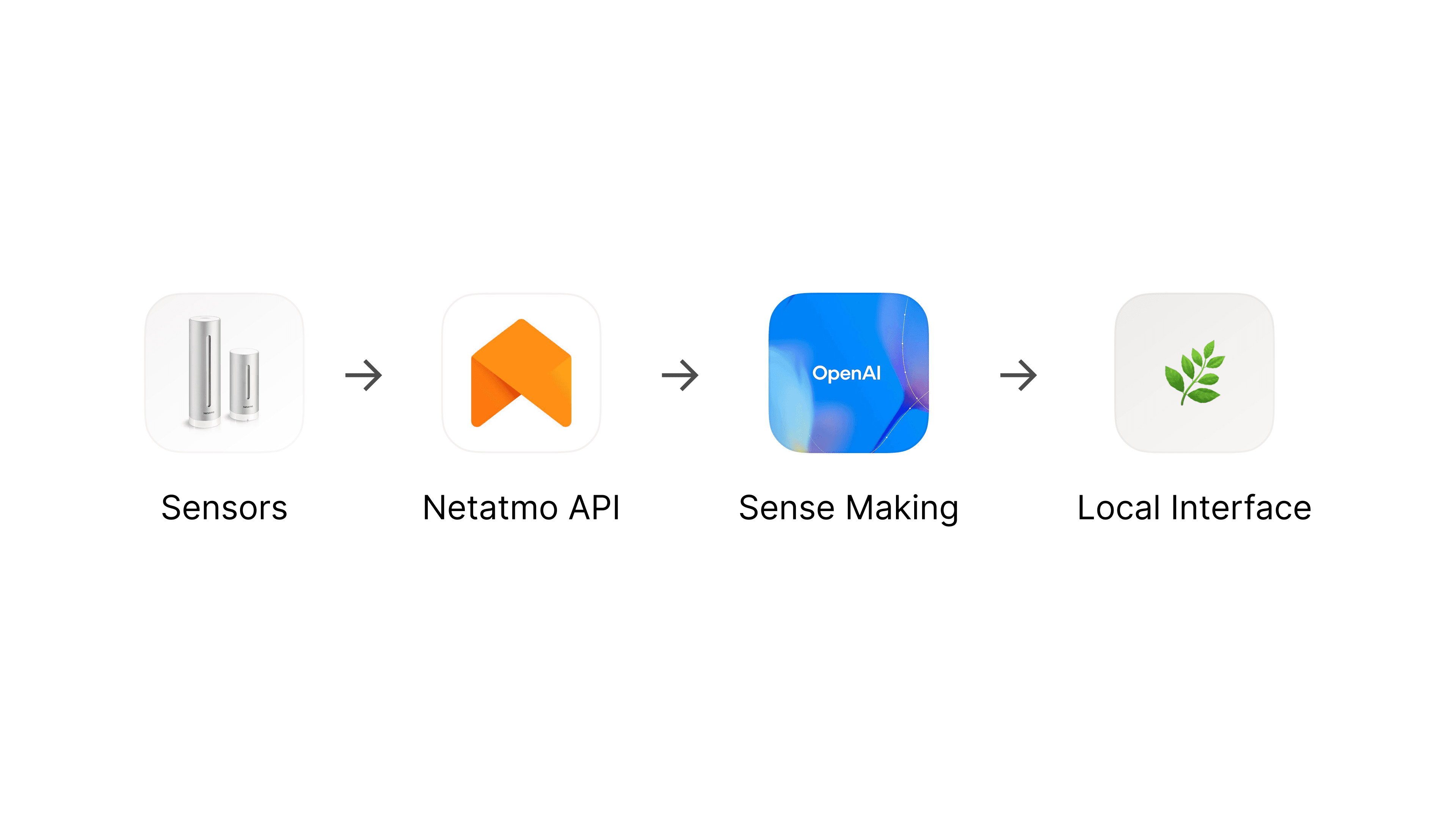
Netatmo API, lightweight local logic, and AI-assisted coding with Codex.
What I built
Local Lens
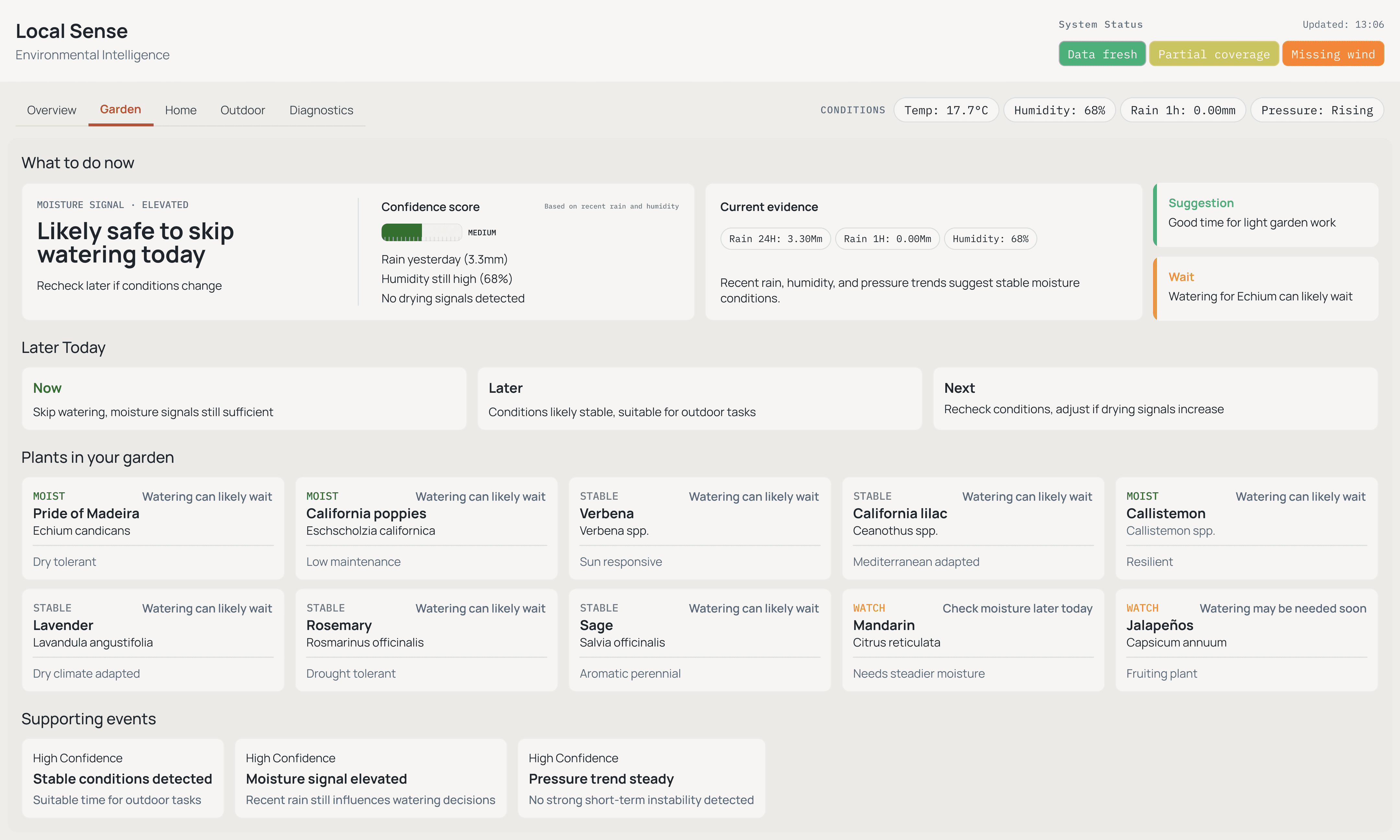
What to do now
I designed a single top recommendation first, so action beats browsing.
Confidence and evidence
Each recommendation shows confidence and evidence chips, so users can see why it appears.
Action buckets
Actions are grouped into do now, wait, and re-check later to make uncertainty manageable.
Plant level guidance
The same weather state is translated into plant specific cues and timing windows.
How decisions are made
Rule based event detection
Local rules read sensor snapshots and short trends, then map them to candidate actions.
Short horizon logic
Decisions target the next 3-6 hours, where real garden actions happen.
Confidence scoring
Confidence combines trend strength, data freshness, and cross-sensor agreement.
Missing data handling
When key signals are missing, confidence drops and the system suggests re-check instead of false certainty.
What failed and what I changed
Early issue
AI sounded too certain
Early prototypes sounded too certain even when signals were weak. Trust dropped because uncertainty was hidden.
Change applied
Split decision logic from language output
I made this split because reliability matters more than fluent wording. Truth, confidence, and action priority are computed by explicit rules, so behavior is repeatable, auditable, and safer when signals are missing (the system can suggest re-check instead of bluffing certainty).
OpenAI is optional and only rewrites the final sentence. Example: if rain in the last 24h is above 2 mm and humidity stays above 60%, action = Wait and confidence = Medium. OpenAI can change how the recommendation is written, but not the recommendation itself.