Connected Learning Journeys into a Scalable Product Loop
Client:
POLIMI Graduate School of Management
Role:
Product Designer
Sector:
AI Learning Platform
Year:
2021 - 2022
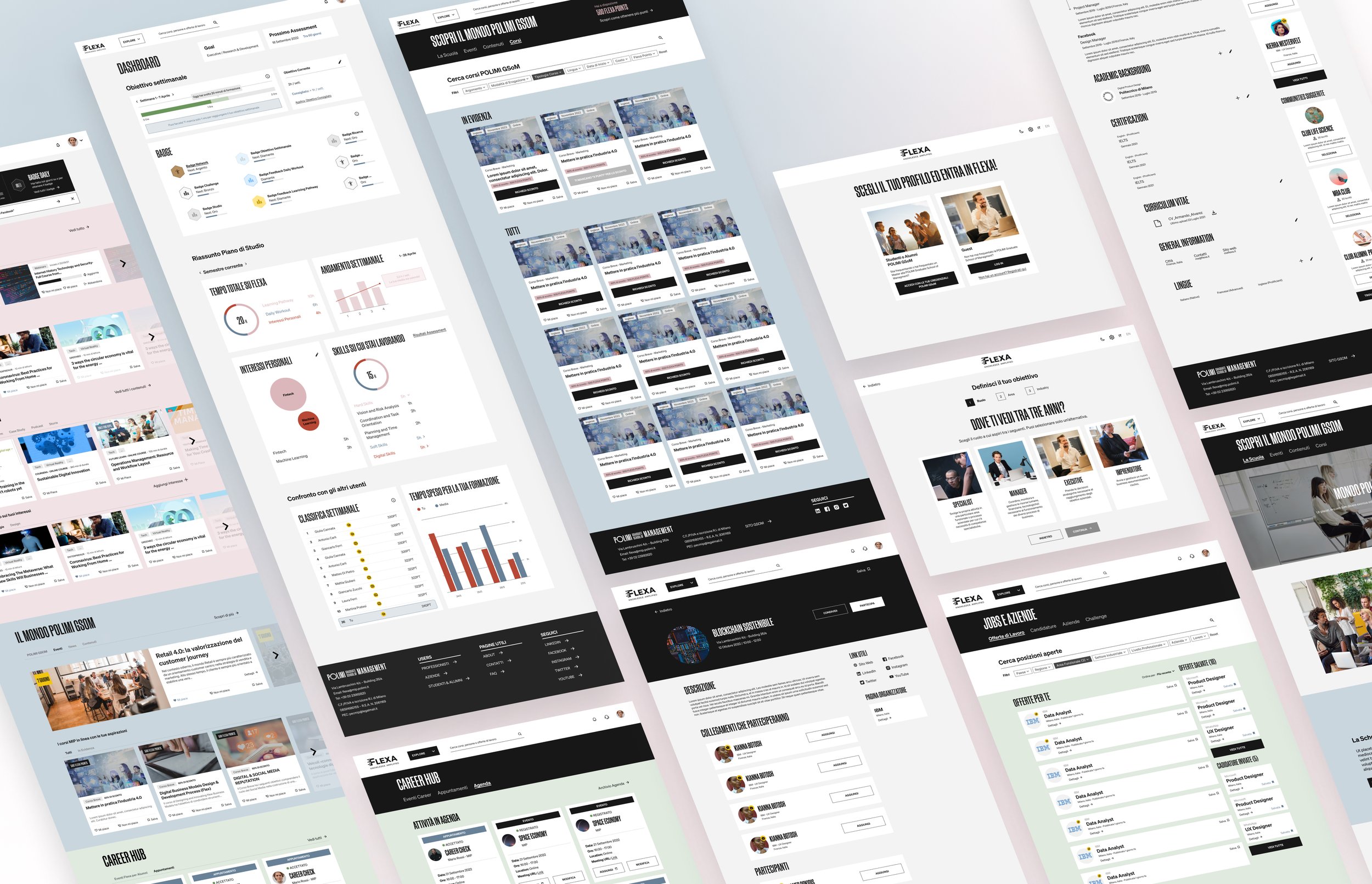
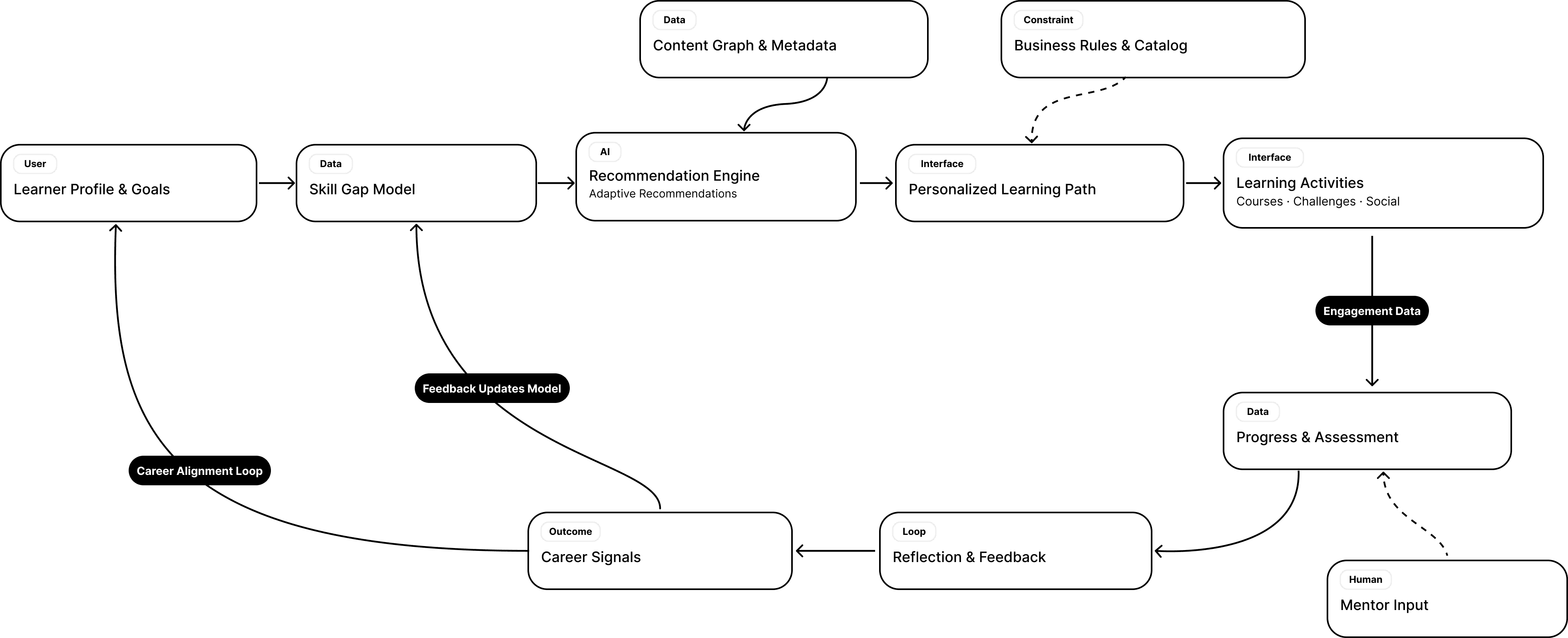
FLEXA was moving from a course catalog toward a product that had to guide learners across onboarding, discovery, recommendations, and progression. I reframed the experience as one connected decision loop instead of separate screens. The objective was to reduce cognitive fragmentation and build a scalable journey structure that could support AI-assisted guidance without increasing confusion.
The Core Problem
Learners entered from different surfaces, but the product did not provide a clear path from initial intent to sustained progress. Onboarding signals were weak, discovery was disconnected, recommendations often lacked timing relevance, and dashboards frequently failed to answer "what should I do next?" Engagement depended too much on user persistence. The core problem was to connect these touchpoints into one progression system with clear checkpoints and reusable decision logic.
Constraints
User constraint: different learner profiles needed different guidance depth in one shared product.
Business constraint: activation and engagement had to improve without adding heavy onboarding friction.
Technical constraint: legacy structures limited recommendation quality and cross-surface consistency.
Organizational constraint: multiple stakeholders needed alignment on one interaction model.
Scalability constraint: architecture had to support AI recommendation expansion.
Key Decisions and Trade-offs
I treated the redesign as journey architecture work, not page-by-page optimization.
I decided to redesign information architecture around progression states, because local screen fixes would keep structural confusion, resulting in a clearer end-to-end backbone.
I decided to add role-aware onboarding cues, because early intent quality drives recommendation relevance, resulting in stronger first-session activation.
I decided to place recommendations at decision-heavy moments, because generic suggestion areas were ignored, resulting in higher perceived usefulness during planning.
I decided to define reusable interaction rules before visual expansion, because prior drift had created inconsistencies, resulting in cleaner design-engineering delivery.
Alternatives explicitly rejected:
Incremental optimization of legacy pages, because it improved local quality while preserving journey fragmentation.
High-automation recommendations without clear intent input, because it would increase noise and reduce learner trust.
Main trade-off: more upfront alignment effort in exchange for stronger long-term coherence and easier scaling.
What I Owned
I owned IA and flow decisions across onboarding, discovery, dashboard semantics, and recommendation entry points. I translated research into decision criteria, led trade-off alignment with product and engineering, and defined handoff rules to keep implementation behavior consistent. I also prioritized progression checkpoints with the highest activation impact and set measurement hypotheses for those checkpoints.
What Changed in the Product/System
The product moved from disconnected touchpoints to a progression-aware journey model.
Onboarding now captures intent signals that inform downstream guidance.
Discovery flow reflects progression state instead of static browsing only.
Recommendation surfaces appear at concrete planning and next-step checkpoints.
Dashboard structure now prioritizes status, next action, and momentum.
Reusable interaction rules increased consistency across modular areas.
This gave teams a shared operating model for shipping new learning features without breaking journey continuity.
Outcomes
Learners reported better understanding of next actions and progression state.
Cross-surface consistency improved through shared interaction rules and checkpoints..
Implementation ambiguity decreased because decision logic was documented before delivery.
What I'd Improve Next
Next iteration would add explainable recommendation controls and stronger cohort-level progression diagnostics. I would also test adaptive guidance thresholds by learner segment to balance personalization and simplicity. That next iteration would improve progression quality while keeping the product understandable for new users.