Turned Fragmented Corporate Pages into a Decision System
Client:
Electrolux Professional Group
Role:
Product Designer
Sector:
Corporate Website
Year:
2023
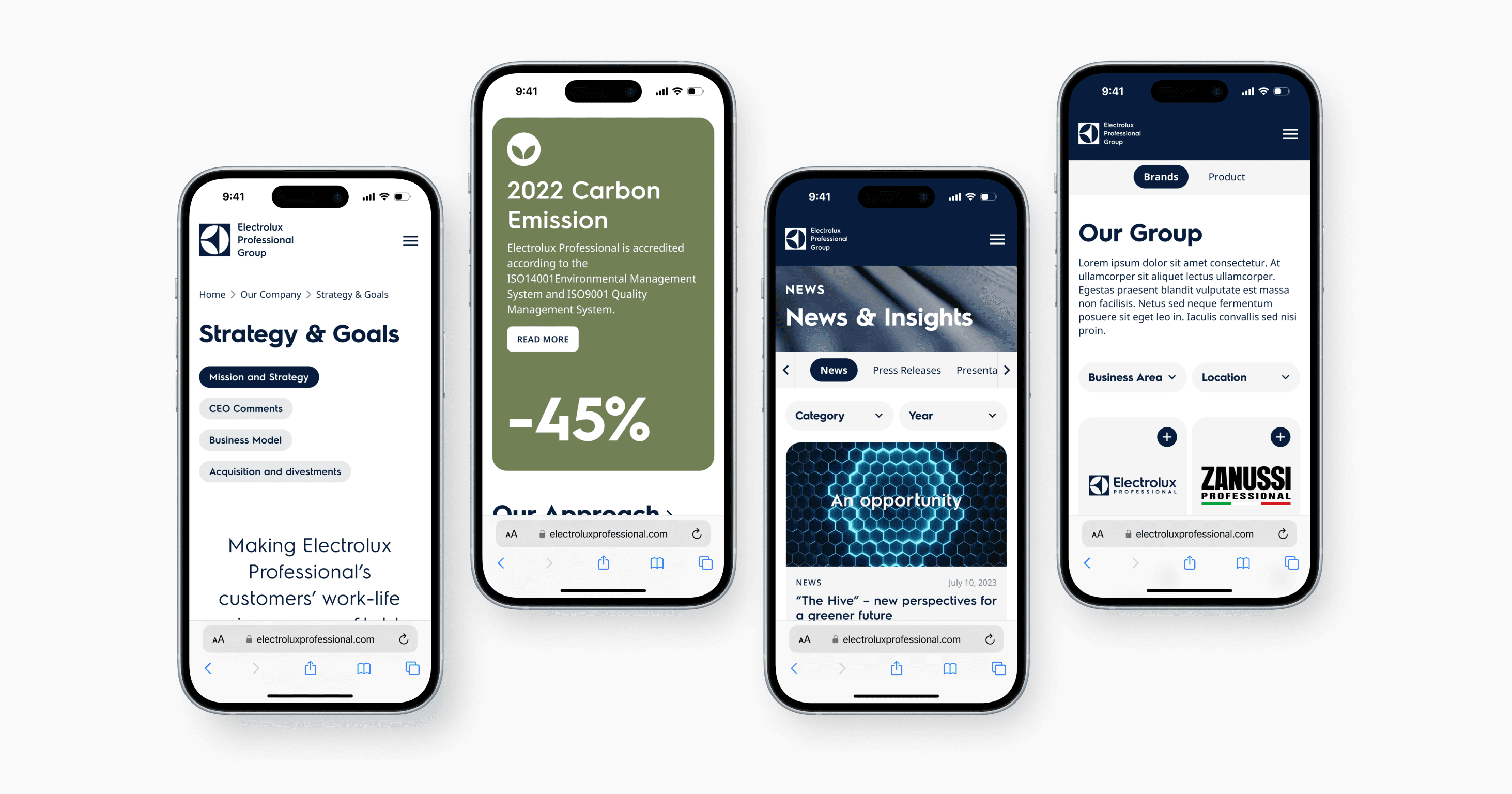
Electrolux Professional’s corporate site had grown into a patchwork of page structures managed by different teams. It looked branded, but users had to relearn navigation logic section by section. I reframed the redesign as a product system: clear page types, shared hierarchy rules, and governed components. The goal was to make decision paths predictable for multiple audiences while keeping authoring scalable for future content growth.
The Core Problem
Users were making similar decisions through inconsistent structures. Investors, partners, and customers often found related information in different layouts, which increased scanning time and navigation errors. Teams could publish quickly, but each new page reintroduced variation because structural rules were weak. This was not mainly a visual issue. It was a decision-architecture issue. The core problem was to create a system that keeps information paths predictable across audiences and across future releases.
Constraints
User constraint: different audiences needed fast orientation with different depth levels.
Business constraint: brand consistency and publishing speed both had to improve.
Technical constraint: redesign had to fit current CMS and implementation limits.
Organizational constraint: many contributors needed clear authoring rules to avoid drift.
Delivery constraint: component behavior had to map to reusable implementation patterns.
Key Decisions and Trade-offs
I treated this as a platform decision problem. We needed fewer one-off page exceptions and stronger template governance.
I decided to define a small set of page types by user intent, because page-by-page customization reduced predictability, resulting in clearer mental models across the site.
I decided to enforce hierarchy templates on priority journeys, because unrestricted editorial freedom caused navigation drift, resulting in faster path completion for high-value tasks.
I decided to bind component usage to governance rules, because visual reuse alone does not prevent structural inconsistency, resulting in stronger design-development alignment.
I decided to prioritize decision-critical blocks above narrative density, because users scanned for action relevance first, resulting in lower navigation depth on key journeys.
Alternatives explicitly rejected:
Optional pattern adoption by local page owners, because it preserved short-term speed but guaranteed long-term inconsistency.
A visual refresh without structural rules, because it improved appearance but not decision clarity.
Main trade-off: contributors lost some layout freedom, but gained a scalable publishing system with clearer quality standards.
Template Assignment Playbook
This playbook is used during page-brief review to assign the page template before design starts.
Operational scenario | Primary signal to check | Assigned template | Description |
|---|---|---|---|
Global entrypoint for all audiences | Corporate/home acts as top-level navigation hub | Homepage | Core journeys and top CTAs are visible above the fold |
Entry page for one section/campaign | Introduces one domain and routes to deeper pages | Starting Page | Section purpose and next actions are clear in first screen |
Browse/compare many items | Users need listing, filters, scan-first navigation | Category Page | Listing supports findability without opening detail pages |
Deep dive on one entity/case | One subject requires full narrative and evidence | Detail Page | Complete single-entity story with clear related actions |
Compliance/policy content | Legal validity overrides marketing narrative | Legal Page | Language is compliant, versioned, and unambiguous |
High-density KPI/comparison content | Decision depends on scanning structured data | Data Dense Page | Data can be compared quickly with minimal interpretation |
What I Owned
I owned the architecture of key page families, including decision criteria, hierarchy behavior, and governance rules connecting design to implementation. I led trade-off decisions with content and engineering, and I defined how teams classify page intent before authoring starts. I also set adoption criteria so template logic could scale beyond the initial launch and survive ongoing content updates.
What Changed in the Product/System
The platform moved from fragmented execution to a governed template system for multi-audience decision flow.
Page-type logic replaced one-off structural choices by local owners.
Shared hierarchy patterns reduced interpretation effort across audience paths.
Component usage now follows explicit governance rules instead of visual preference.
Publishing reviews evaluate decision clarity and path logic, not only visual completeness.
New content starts from template logic, reducing repeated architecture debates.
In daily operations, contributors now ship faster within clear boundaries, and users encounter more predictable decision paths across sections.
Outcomes
Stakeholders reported faster orientation across audience-specific sections.
Design-development consistency improved through shared template and component governance.
Future fragmentation risk decreased because new pages now inherit structural baselines.
What I'd Improve Next
Next iteration would add journey analytics by page type and decision checkpoint, then connect thresholds to template evolution rules. I would also classify recurring exception requests to separate real template gaps from local preferences. That next iteration would keep the system adaptable without losing structural coherence.