Scaled Global Consultation Governance Across 9,200 Stores
Client:
Amplifon Group
Role:
Product Designer
Sector:
Healthcare Retail Platform
Year:
2024 - 2025

Due to NDA constraints, I cannot share explicit product screens. This case focuses on project scale, decision model, and operational rollout.
This work was part of Amplifon’s broader CRM transition toward Salesforce. The challenge was to scale one consultation experience across 9,200+ stores in 25+ countries while aligning design decisions with platform feasibility. I redesigned the consultation model around a global core with controlled local configuration, working directly with Salesforce-specialized developers to validate what could be standardized, what had to be configurable, and what required technical compromise.
The Core Problem
Specialists had to compare devices, configure options, and generate quotes while speaking with customers in real time. Across markets, the same consultation moments were implemented with different structures, labels, and validation rules. That fragmentation increased training time, raised implementation defects, and made each rollout negotiation-heavy.
The product needed to support local legal and commercial differences without losing global speed, consistency, and delivery control. The core problem was to protect local relevance while avoiding permanent UX forks market by market.
Salesforce CRM Transition & Technical Feasibility
This redesign sat inside a wider CRM transition to Salesforce. That context changed how design decisions were made: every key interaction pattern had to be validated against Salesforce constraints and implementation effort with the specialized Salesforce development team.
We ran feasibility checks on concrete consultation moments, including:
Consultation and product comparison structures
Hearing test presentation and interpretation modules
Booking and consultation flow modules connected to CRM entities
The design trade-off was explicit: preserve consultation clarity for specialists while staying within platform constraints, delivery windows, and configuration boundaries. Instead of over-designing unconstrained concepts, we prioritized patterns that could be implemented reliably within the Salesforce migration path.
Constraints
User constraint: specialists needed fast reading and low cognitive load during customer-facing consultations.
Business constraint: leadership needed faster rollout and lower variance across markets.
Technical constraint: one architecture had to handle local catalog, pricing, and regulatory rules within Salesforce migration constraints.
Organizational constraint: country teams needed autonomy without creating permanent UX forks.
Governance constraint: change requests needed explicit ownership and approval boundaries.
Key Decisions and Trade-offs
I treated this as a product operating model decision, not a visual refresh.
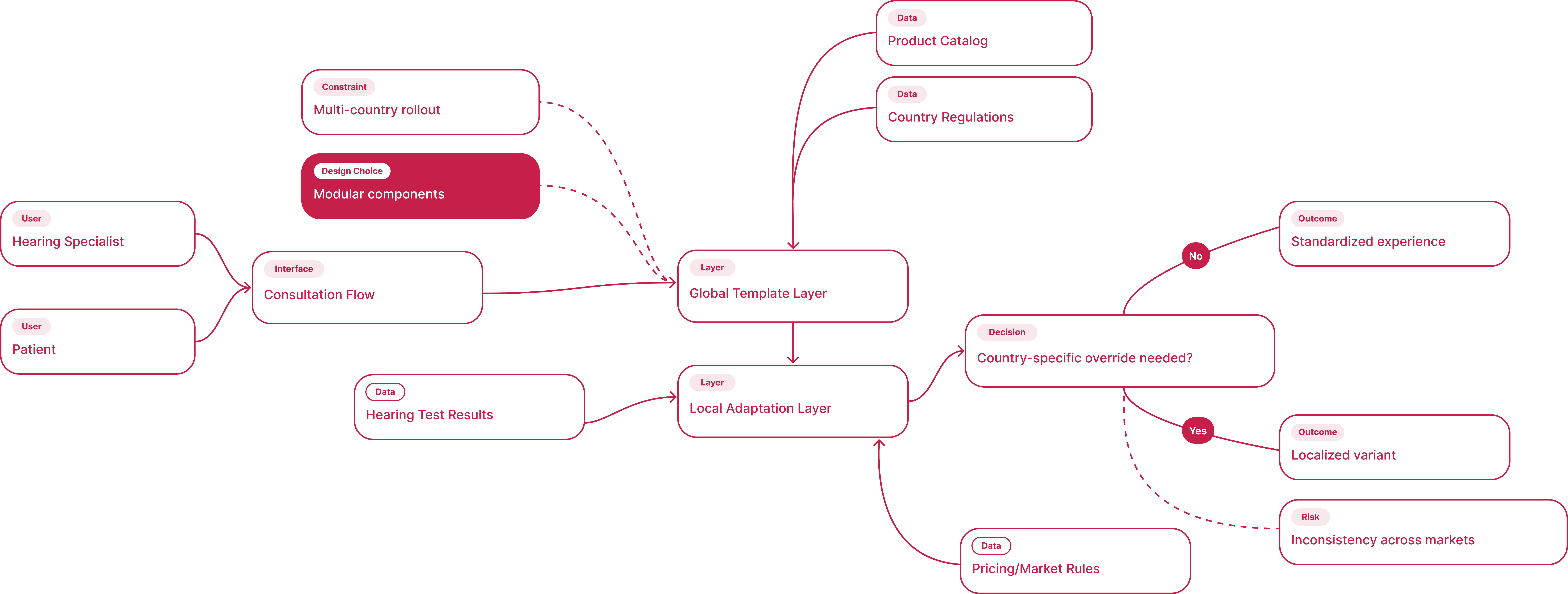
I separated a global consultation core from local configuration layers, because free-form local branching was driving rework, resulting in faster rollout planning and fewer custom implementations.
I defined strict rules for what was configurable versus what required core change, because unclear boundaries caused repeated escalation loops, resulting in cleaner prioritization between market teams and central product.
I standardized high-risk comparison and quote states, because inconsistent states caused training errors and QA drift, resulting in more predictable specialist behavior and more reliable releases.
I used progressive disclosure in dense comparison moments, because full-detail layouts slowed live conversations, resulting in quicker scans and fewer interaction pauses in store.
I aligned consultation stages with rollout governance gates, because late technical decisions were blocking delivery, resulting in earlier feasibility checks and fewer handoff surprises.
I aligned core consultation vocabulary across markets, because label drift created hidden training cost, resulting in faster onboarding and more consistent specialist communication.
Alternatives rejected:
Country-by-country interaction forks, because short-term local speed would continue increasing long-term maintenance debt
Near-total centralization, because it would reduce local compliance fit and market adoption
Main trade-off: local teams gave up part of pattern freedom, but gained faster delivery, stronger implementation quality, and clearer decision accountability.
What I Owned
I owned consultation interaction architecture across core flow, comparison logic, and quote behavior. I defined the global-core/local-config boundary, led trade-off decisions with product and engineering, and translated governance requirements into implementable rules.
I also co-led feasibility alignment with Salesforce-specialized developers to ensure that key consultation patterns were technically viable in the migration context, not only conceptually correct at UX level.
Design System Adoption & Contribution
A second critical track was design system adoption. The specific product stream I worked on was behind Amplifon’s newer visual language and needed to converge to the updated system while still shipping roadmap priorities.
I drove adoption and contribution through concrete actions:
Aligned legacy consultation screens to the updated visual language and component rules
Standardized consultation-domain patterns (comparison blocks, data cards, state handling) to reduce one-off UI variants
Defined reusable variants and behavior rules so teams could scale configurations without re-designing core patterns
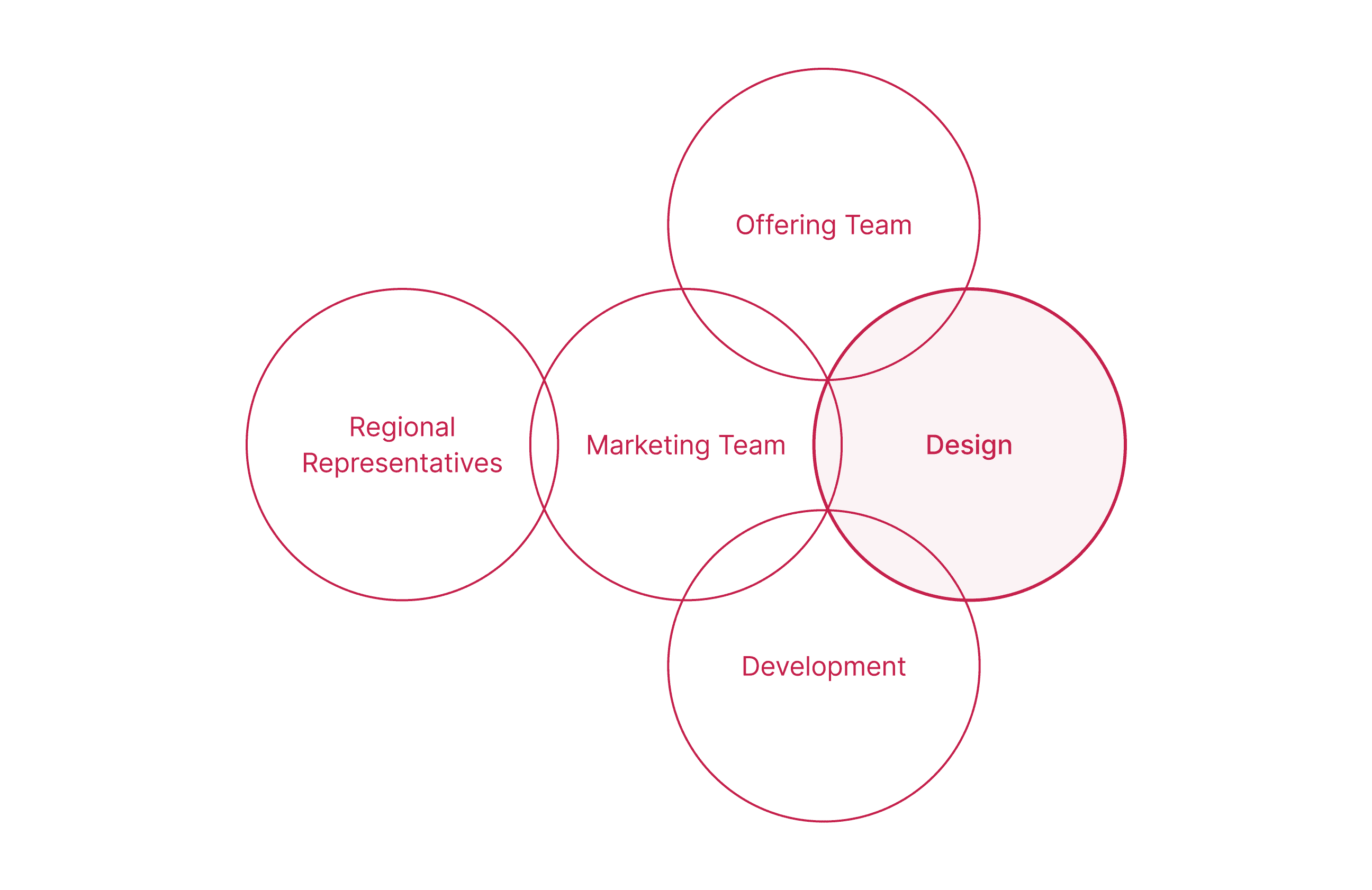
Used shared component governance with engineering to keep UI consistency and implementation feasibility synchronized
It was active contribution, the consultation domain fed back requirements into systemized patterns that improved scalability for future markets.
What Changed in the Product/System
The product moved from market-level variation to a shared consultation system with controlled adaptation.
A reusable consultation baseline replaced multiple ad hoc flow variants
Local differences moved into configuration instead of structural UX forks
Comparison and quote states became standardized across markets
Release reviews shifted from preference debates to rule-based validation
Handoff quality improved because technical constraints were validated earlier with Salesforce specialists
Design system consistency improved because legacy areas adopted shared patterns and reusable variants
Outcomes
Cross-market rollout consistency improved because teams shipped from the same consultation baseline
Implementation variance decreased because local requests followed explicit configuration boundaries
Consultation patterns were more implementation-ready thanks to early Salesforce feasibility validation
UI consistency increased in a previously lagging product stream through active design system adoption and contribution
What I'd Improve Next
Next iteration would add stage-level instrumentation by market to detect where local adaptations still slow consultations. I would also define escalation thresholds, when the same local exception repeats, it is promoted to core pattern review with both product and Salesforce engineering.