Embedded AI Recommendations into Campaign Decision Workflows
Client:
Confidential
Role:
Product Designer
Sector:
Enterprise CRM
Year:
2026
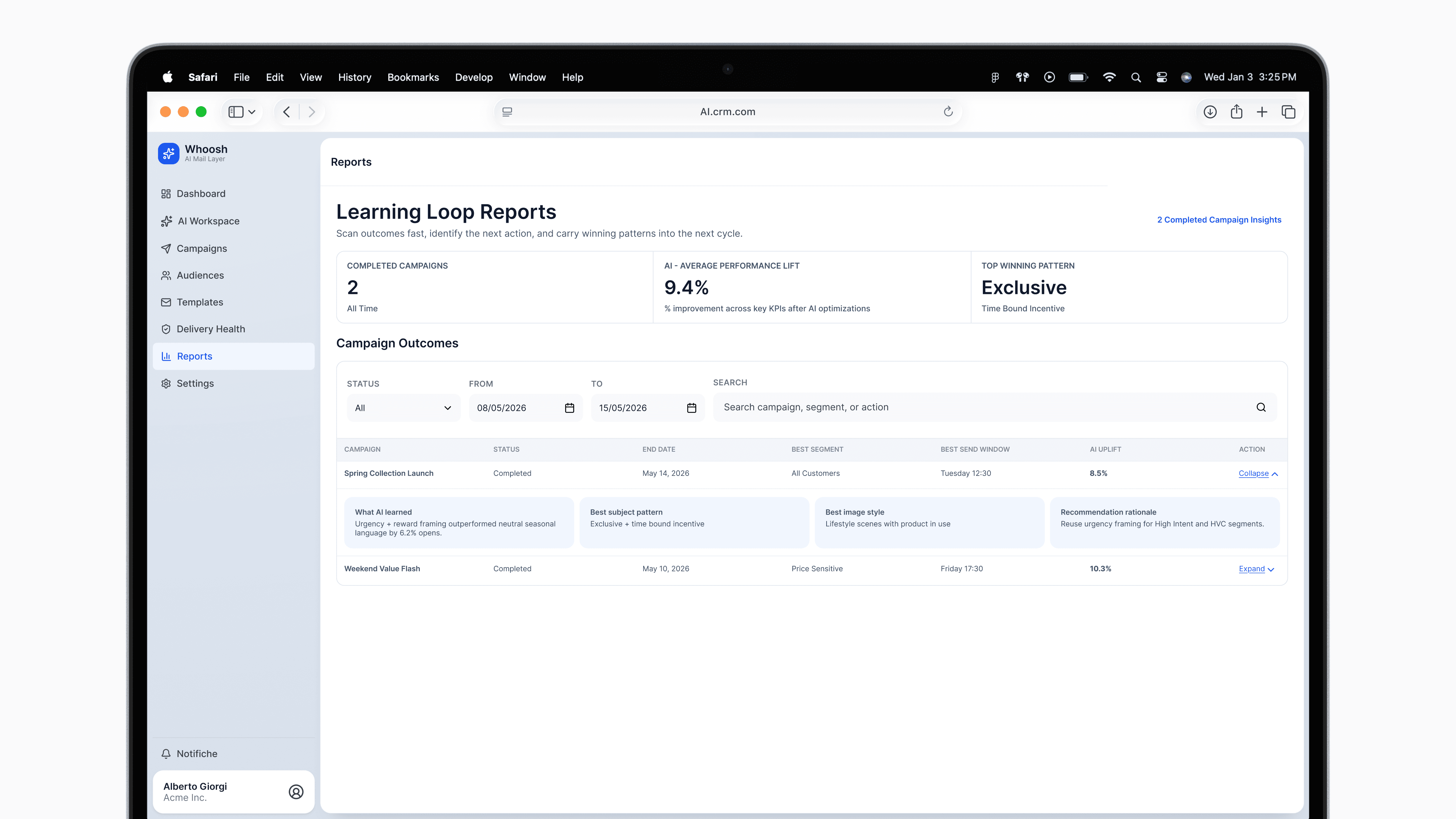
Due to NDA constraints, product screens have been intentionally anonymized. This case focuses on decision logic, workflow design, and operational impact.
CRM teams were running high-volume campaigns in a compliance-sensitive environment, but key optimization decisions were still manual and inconsistent. I shifted the concept from AI-first orchestration to workflow-first decision support to improve campaign speed and quality without weakening approvals, sender protection, or accountability.
The Core Problem
Campaign teams had a mature delivery stack, yet creative updates, audience checks, and scheduling decisions were fragmented. Similar campaigns were reviewed with different criteria. That increased cycle time and output variance. The early direction used a central AI orchestration surface. In review, teams flagged a risk: weaker visibility on why actions were suggested and who owned final decisions before send. The problem was to reduce manual friction while keeping governance, traceability, and operational trust.
Constraints
These constraints shaped the product boundary:
User constraint: operators needed faster decisions without losing final approval control.
Compliance constraint: template zones and execution paths required explicit controls and auditability.
Technical constraint: existing CRM and delivery services could not be replaced in one release.
Operational constraint: teams needed predictable behavior under delivery pressure.
Risk constraint: low tolerance for opaque automation on high-impact actions.
Orchestration constraint: conversational support could appear only at high-value checkpoints.
Key Decisions and Trade-offs
I reframed the direction around one decision: should AI run the workflow, or strengthen existing checkpoints?
I scored both directions against delivery-critical criteria before committing.
Decision Criteria | Weight | AI-first | Workflow-first |
|---|---|---|---|
Time-to-value in current operations | 20 | 2 | 5 |
Deliverability and sender-reputation protection | 20 | 2 | 5 |
Compliance fit and traceability | 20 | 2 | 5 |
Adoption friction | 15 | 2 | 4 |
Integration risk | 10 | 2 | 4 |
Decision accountability | 15 | 2 | 5 |
Weighted total | 100 | 2.0/5 | 4.7/5 |
I chose workflow-first, with conversational support activated only when routing or diagnosis ambiguity slows execution.
Prototyping Real Interactions
Agent Builder was used to prototype policy logic: intent routing, checkpoint selection, and handoff timing.
Widget Builder was used to prototype widget interactions, then validate them inside those agent test flows.
These were design-validation tools, not a claim that the final runtime UI used the same builder interfaces.
I made three product decisions to execute that direction:
I decided each recommendation must include rationale, confidence, and reversibility, because hidden logic weakens trust, resulting in faster and safer review decisions.
I decided conversational entry points should be limited to specific checkpoints, because always-on chat increases ambiguity, resulting in cleaner handoffs to deterministic workflow steps.
I decided to enforce editable and locked template zones plus explicit high-risk approvals, because unrestricted generation raises compliance risk, resulting in stronger governance under audit.
We gave up AI novelty and autonomous behavior to gain higher trust, faster adoption, and safer execution.
Workflow-first with controlled conversational checkpoints delivered the best balance of speed, control, and accountability.
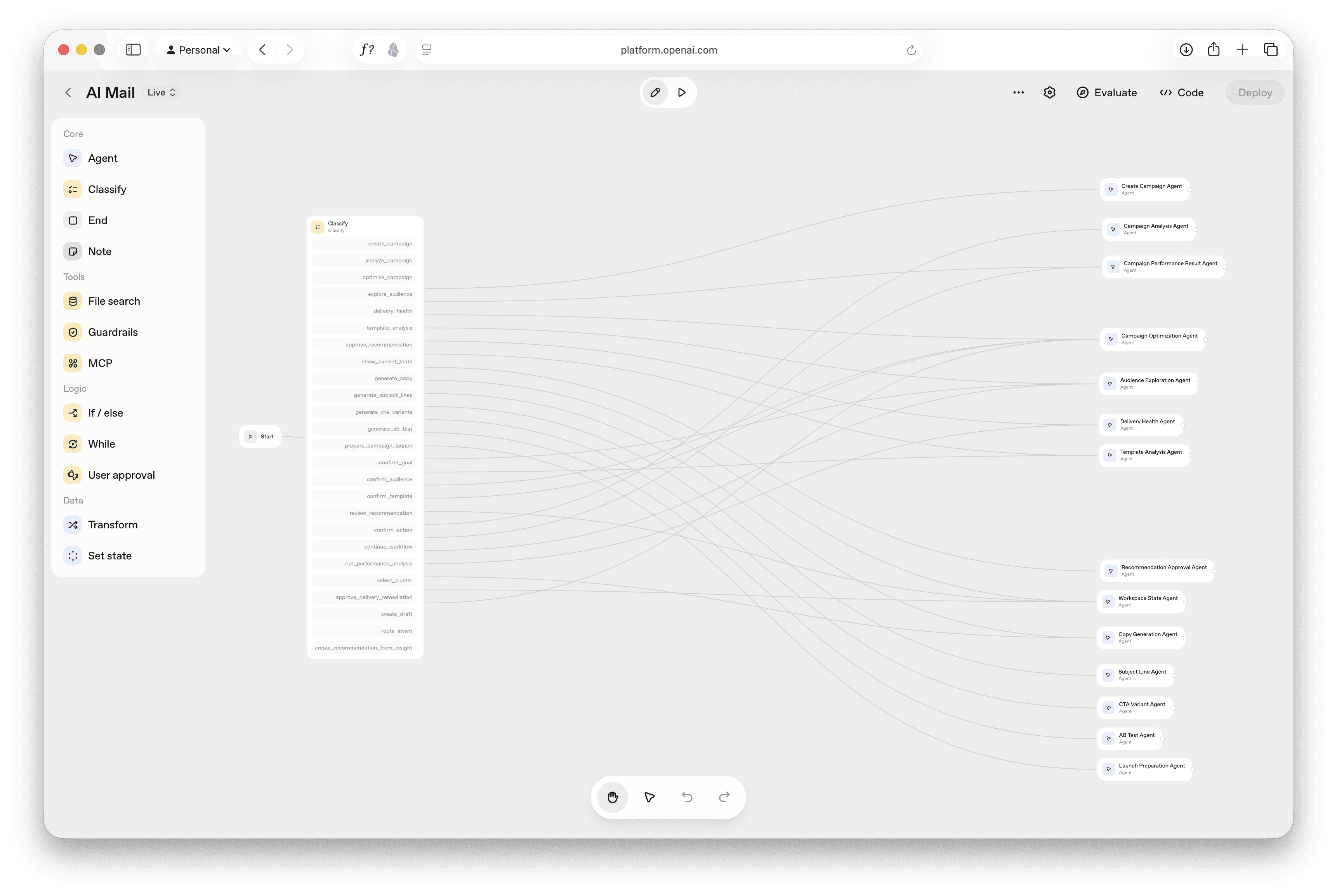
Agent Builder test flow used to validate routing policy and handoff timing.
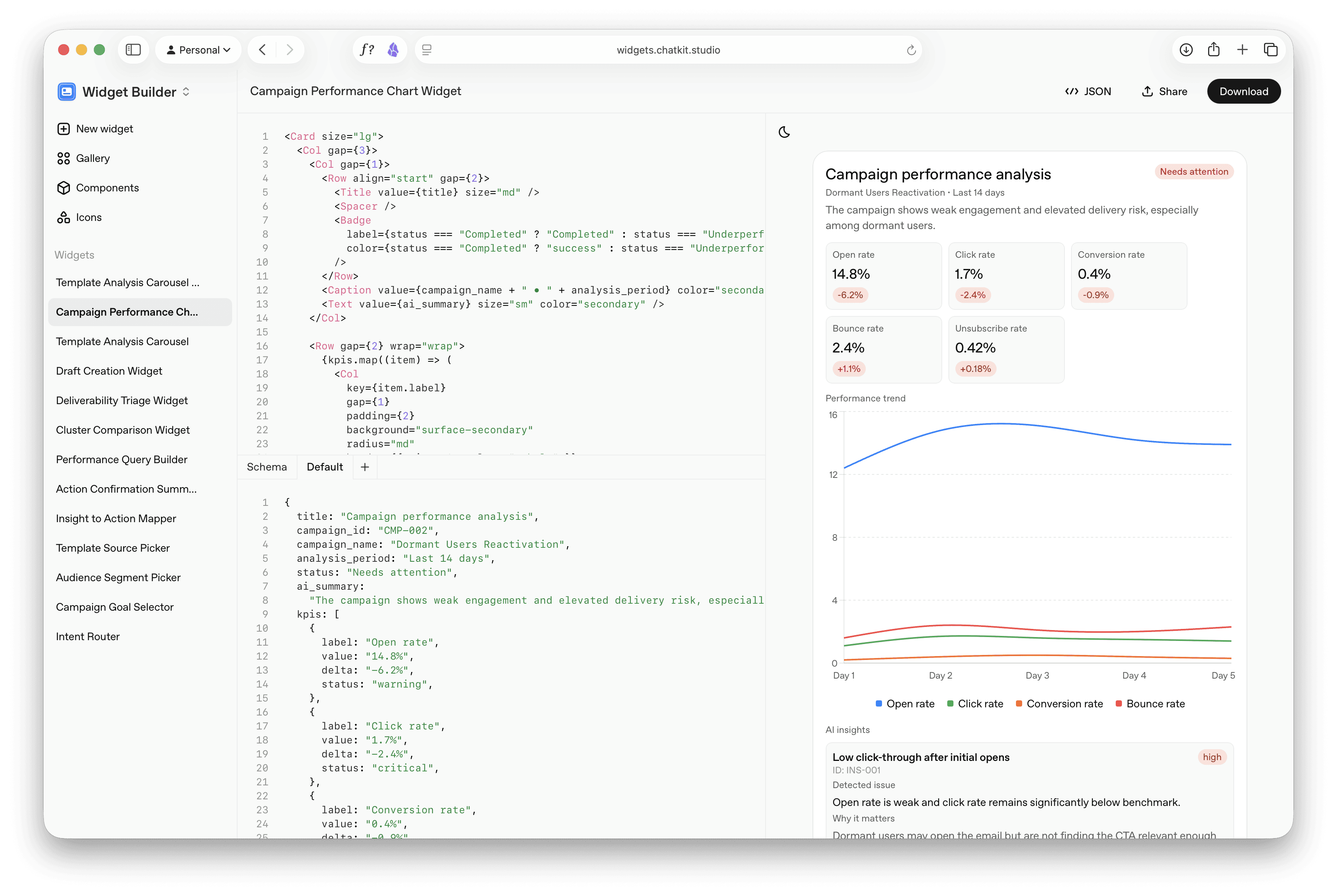
Widget Builder was used to define widget behavior before validation in agent test flows.
What I Owned
I owned the pivot from AI-first orchestration to workflow-first decision support, including the decision framework, interaction model, and governance boundaries. I defined the agent decision policy: which widget to invoke, when to invoke it, and when to hand off to deterministic workflow steps. I also defined recommendation object rules, approval semantics, and rollout sequencing with product and engineering. My ownership was interaction policy and decision logic, not locking the final implementation stack to the prototyping tools.
What Changed in the Product/System
The concept moved from a separate AI surface to a widget-based decision workflow with explicit policy and structured handoffs.
Recommendations appear inside campaign stages where operators already decide.
Policy logic routes ambiguous intents to the right checkpoint before structured execution.
Recommendation objects show rationale, confidence, expected effect, and rollback path before commit.
High-risk actions require explicit confirmation, and template rules enforce editable versus protected zones.
Operationally, teams moved from fragmented manual checks to structured review decisions with clear ownership at each step.
Outcomes
Product direction became production-ready because controls were embedded in existing workflow checkpoints.
Adoption risk decreased because operators reviewed recommendations in familiar stages, not in a separate orchestration surface.
Decision clarity improved because conversational support was limited to checkpoints where routing or diagnosis ambiguity existed.
Review quality improved because rationale and reversibility were visible before approval on sensitive actions.
What I'd Improve Next
Next iteration would tune policy thresholds by intent confidence and campaign risk profile, then add QA checks on router-to-widget handoffs. I would expand specialist-widget coverage only where failure patterns repeat. This keeps governance and approval accountability stable while automation coverage grows.